
Know your UV resin and cleaning agent
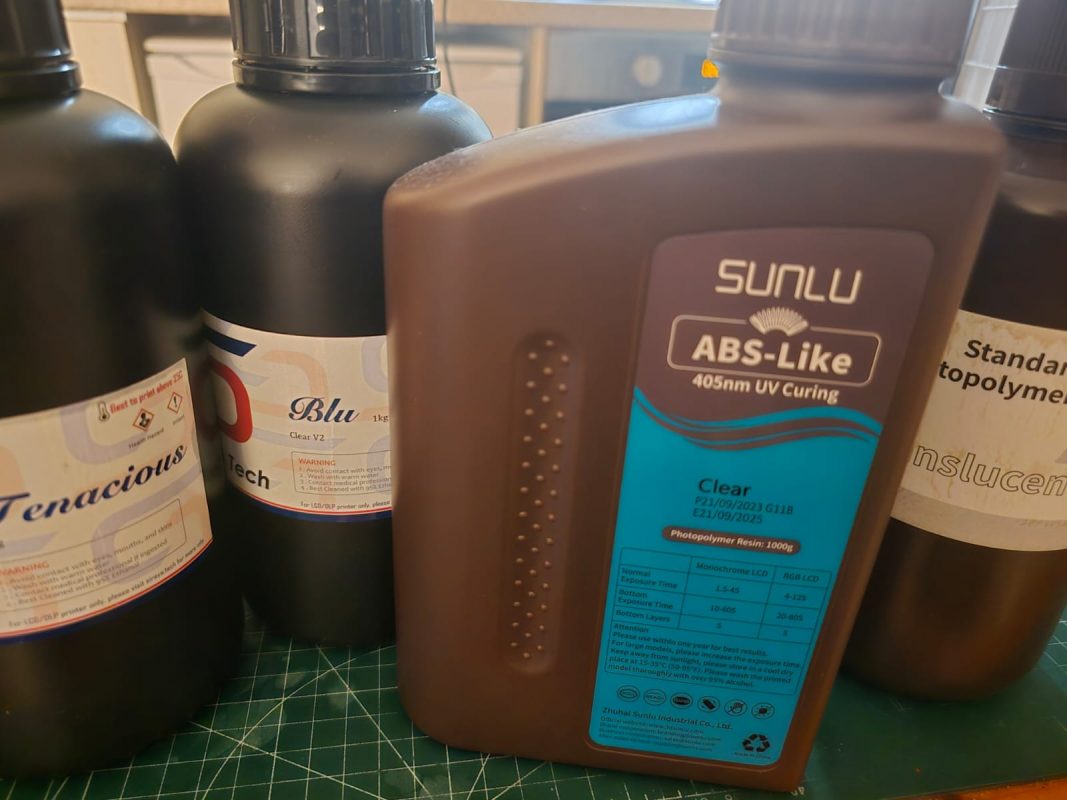
Unlike FDM filaments, UV resin can vary significantly between different brands. Instead of offering a wide range of materials, UV resin’s performance is largely determined by its additives. The main types of UV resin include:
- Standard Resin / High-Resolution Resin
- Engineering Resin
- Casting Resin
- Tough Resin
- ABS-like Resin
When mechanical properties are crucial, standard or high-resolution resin should be avoided due to their brittleness and inability to withstand impacts. Additionally, while water-washable resin may seem appealing, it does not perform as well as non-water-washable resin without washing with isopropyl alcohol (IPA).
For lure making, several measurements are worth noting when choosing a resin:
- Shore Hardness
- Tensile Stress
- Young’s Modulus
- Heat Deflection Temperature
- Water Absorbption
Regarding shore hardness, there are two types of shore durometers commonly used: Type A and Type D. Type A is designed for softer materials, while Type D is generally harder. For lure making, the focus should be on Type D, unless flexible parts like tail fins are required.
Tensile stress indicates the amount of force a material can withstand before breaking. It is crucial for determining the strength and durability of a material.
Young’s modulus measures the stiffness or elasticity of a material, helping us understand how much a material will stretch or compress under force. A high Young’s modulus means the material is very stiff, while a low Young’s modulus means it is more flexible.
Heat deflection temperature shows how a material’s mechanical properties change at different temperatures.
One of the biggest concerns we need to address is water absorption. From my own testing with more than 10 different brands and resin types, none have lasted longer than 24 hours in water due to a process known as plasticisation. Inevitably, they all become brittle over time. Most consumer-grade UV resins have around 2% water absorption, which makes them unsuitable for underwater use.
In conclusion, unless a UV resin has exceptionally low water absorption (below 0.3%), it may not be a viable option. Otherwise, I would not recommend using UV resin printing for making fishing lures. Some brands, such as Protolab, claim to achieve this, but if you choose to try them, do so at your own risk.
Solvents for washing your print:
- Isopropyl Alcohol (IPA)
- Denatured Alcohol
- Acetone
IPA is the standard washing agent needed to remove any residues after printing. While acetone and denatured alcohol may offer better cleaning power, they have a stronger smell. (Note: Acetone can damage your print, so use it carefully.) Ultimately, it is a matter of personal choice, but I recommend sticking with IPA to allow for more room for errors.
