
Know the limitation of filaments
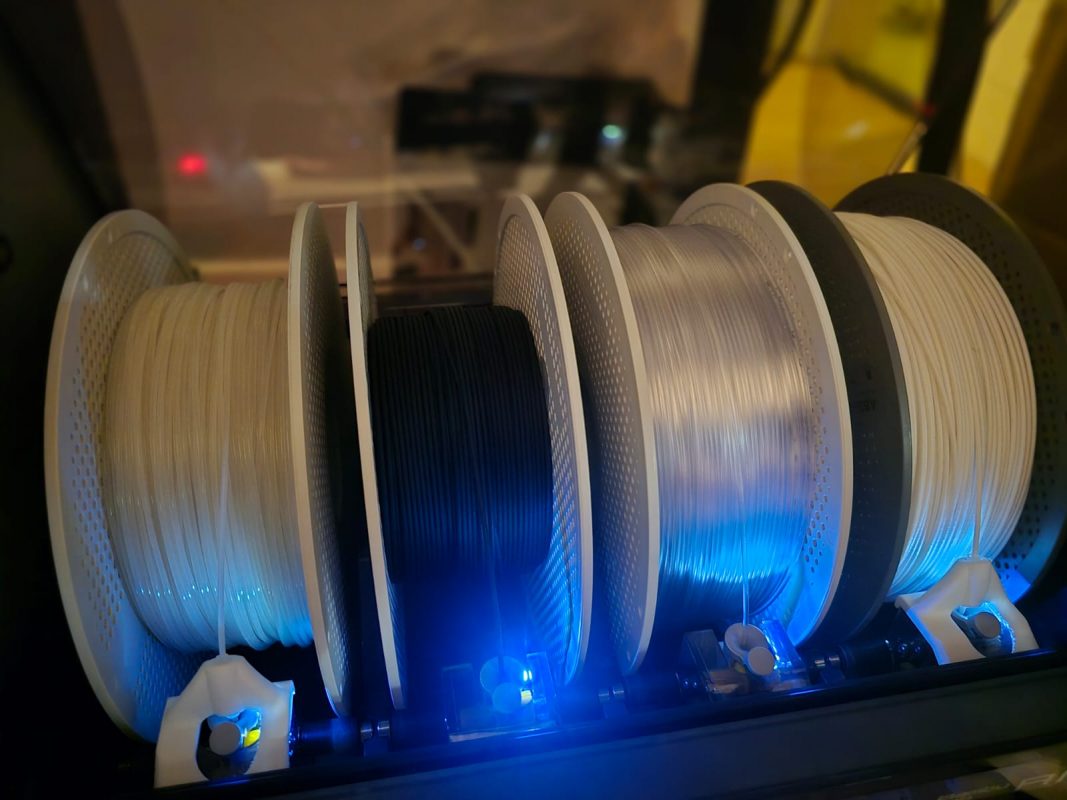
Pic 1: Filaments in AMS, PLA/PLA CF/PETG/ABS. (from left)
Fused Deposition Modeling (FDM) printers are perhaps the most widely used machines in the 3D printing industry. The commonly used materials include:
-
PLA
-
PETG
-
ABS
-
TPU
-
ASA
While PLA is the most cost-effective material, it is not recommended for outdoor applications due to its rapid degradation under UV light. Additionally, PLA is quite brittle and may shatter upon impact. Its hardness also makes post-processing tasks such as sanding and drilling challenging. However, PLA is an excellent material for prototyping as it does not require an enclosure to maintain the printer’s temperature or a high print-bed temperature.
PETG is considered an upgrade by many due to its improved impact resistance while maintaining ease of use similar to PLA. However, it still degrades like PLA.
ABS is perhaps the most well-known material outside the 3D printing industry. Many manufactured fishing lures are made of ABS injection moulding. It offers better impact and UV resistance than PLA and PETG while remaining affordable and available in a wide variety of colours. However, ABS has two main drawbacks:
-
It warps when the temperature is not stable enough.
-
It emits High Volatility Organic Compounds (HVOCs).
To address the warping issue, users are advised to use an FDM printer with a pre-built enclosure, which is generally more expensive. Alternatively, a grow tent can also be used. For HVOCs, it is recommended to attach an inline ventilation fan to the enclosure to extract air outdoors, where the HVOCs will be diluted and degraded. Additionally, a filter with activated carbon is a wise addition.
TPU is probably the most challenging material to work with in 3D printing. It generally does not go through Automatic Material Systems (AMS), clogs the printing nozzle, and warps. Its only advantage is its flexibility, comparable to rubber. While it is possible to print lure fins with TPU, plastisol is a more reasonable choice.
ASA is considered a superior alternative to ABS, offering better impact, UV, chemical, and temperature resistance (Note: HVOC problem remains). It was engineered as a replacement for ABS from the beginning. The only downsides are its higher printing temperature, lower moisture tolerance, fewer color choices, and higher cost.
In conclusion, ABS and ASA are both viable options to print fishing lure in terms of mechanical properties. But because of the existence of HVOC, setting up a contained printing area with inline ventilation is highly recommended.
