
TLDR (FDM)
The following experience is based on my own trial & error.
Personally I use SUNLU ABS white(avoid using ABS+ as there is additive which may weaken its strength.
- Bed Adhesion: Set the bed to 105–110°C and use a glue stick for improved adhesion. Some may argue against using glue, but it’s not worth adjusting all other settings just to avoid it. Also, always use brim, raft if necessary.
- Z-layer Adhesion: Increasing the temperature by 10°C above the recommended range (from 250–260°C to 270°C) completely resolved the layer adhesion issue, though it may cause slight surface warping in some areas.
- Patterns: Adding patterns or a “fuzzy skin” helps reduce surface contraction on the X-Y plane, which can eliminate most of the wrinkle-like warping. (Each unit is just 0.15 mm in diameter and raised 0.05 mm above the surface.)
- Z-hop:
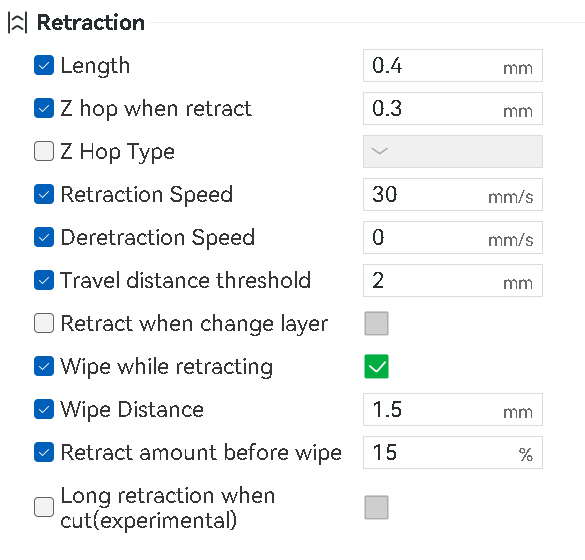
I personally use the Bambu X1C, and you can apply these filament settings under “Setting Overrides” for printing multiple pieces at once. Using these settings has resolved all my collision issues. - Wall and Infill: Two to three wall layers are sufficient to provide reasonable toughness. Keep the infill at 10–15% unless you specifically want to adjust buoyancy. Avoid using grid infill, as the overlapping paths can increase the risk of collisions.
- Overhangs:
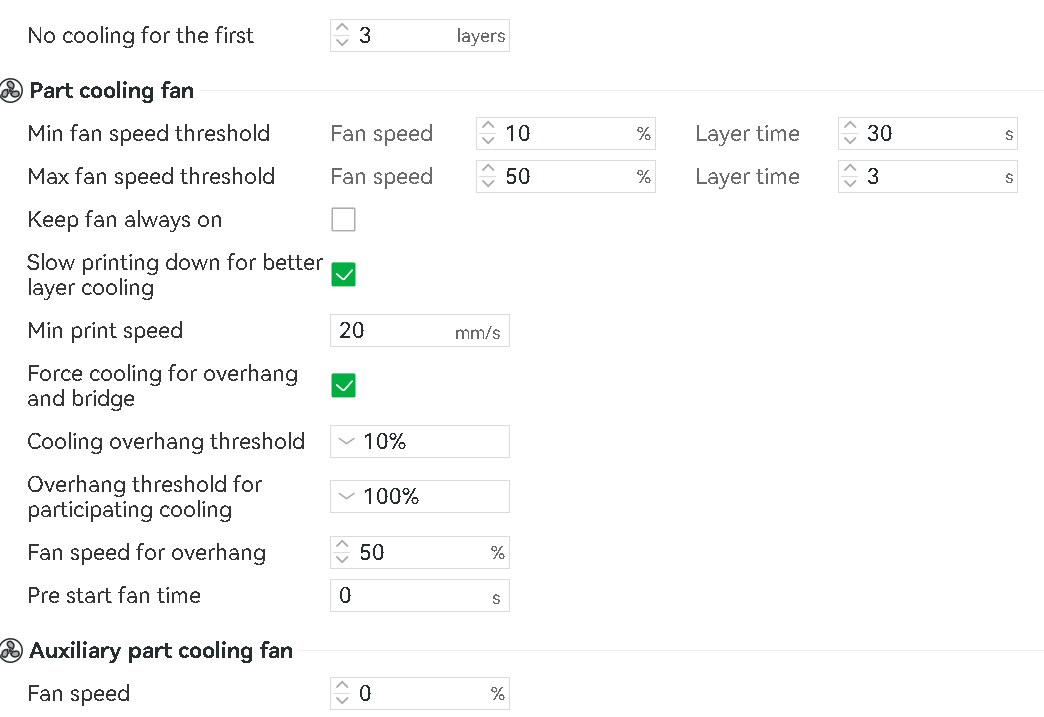
Follow this part cooling fan settings for better finish on overhang surface when using SUNLU ABS.
- Layer height:
Use a 0.08 mm layer height for optimal quality. If your model is mostly covered with a scale pattern, the layer lines should remain invisible even after applying primer.
Note: Primer can reveal all surface flaws, including layer lines.
- Smoothing:
Since we are using ABS, applying a layer of acetone can help smooth the print. Some suggest vapor smoothing for an even better finish, but it requires a dedicated setup for safe use and can inadvertently smooth out mechanical parts, which is often undesirable.
Personally, I rely on an electric polisher to remove the wrinkle-like warping, as most other areas are protected by a custom scale pattern.
